Monday, October 26, 2020
Revised Prison of the Hated Pretender Release
A revised, updated, edited, illustrated and annotated version of my 2012 Prison of the Hated Pretender is now available for purchase and download at DriveThruRPG. The adventure is introductory, and now includes copious notes on running classic style adventures as well as conversion details for 5th Edition D&D.
Published through the amazing Hydra Cooperative, and available here:
DriveThru Link
Tuesday, August 18, 2020
The Hinterlands of Empire
"Men make their own history, but not as they please, not out of the
conditions he chooses, but under existing circumstances - transmitted
from the past; the traditions of past generations weigh like a nightmare
on the brain of the living."
The Successor Empire is sadly reduced by secession, war, conquest, depopulation and decline.
The Central Provinces of
Empire, the only ones loyal to the Emperor, and not claimed by naval mutineers, rogue dux, plague
cults, Resurgent Kings or the Solar Popes are top heavy with the
accretion of the past. Every foot of ground has been a field, a home, a
barracks and a grave at least once, and almost every mile contains some
ruined magnificence - tumbled blocks showing the forgotten master-work
of a long dead sculptor lay in a field of alchemically altered flowers,
poisonous, but in the perfect jeweled tones to celebrate some ancient
Emperor's jubilee.
Even in their wounded grandeur, nibbled at the edges by betrayals and crusades, the Central
Province alone is larger then most kingdoms, stretching from the
polluted crater lands South and West of the Capital to the
Blue Meadows in in the North. Canals and imperishable high-roads radiate
from the Capital to run ruler straight across the provinces, surrounded by tumbled stones and monumental arches of bonewhite that still gleam for past victories - appreciated only by jack rabbits and sparrows for the shade they cast. Even fertile regions such as Green Hive are
beset by internal feuding among their noble magnates and invaders from
without. Pirate princes from the Province Maratime sail ever Northward,
penetrating the rivers and canal networks in brazen plundering
expeditions while local militias rob traders and each other. Everyone
know that The Empire is sick, collapsing from the decadent weight of its
own glory, but the fall has been so long coming that even those who
care put off hard choices for years or generations while the Empire
dies in nearly geologic time.
![]() |
| The Successor Empire and its Rivals |
Thursday, May 24, 2018
Goodbye and Good Luck
Well some of you may have noticed this blog has been down, restricting access for some time. For various reasons I've decided to step away from the OSR and the tabletop gaming web community - possibly permanently. Part my decision to withdraw is personal, I find myself with insufficient time and desire to write about games but I also have the sense that the 'OSR' scene this blog is devoted to has become a rather disgusting place where crass commercialization is strangling a formerly creative amateur community, and where destructive 'alt-right' views are becoming increasingly prevalent, even among some of the more significant publishers in the community. This isn't to say that there aren't still wonderful creatives and writers within the OSR community, and that I don't consider many of those I've met there real friends.
![]() |
| My longtime favorite Dave Trampier piece from the 1st edition DMG |
So Goodbye and Good Luck, thanks for reading.
- Gus L.
Monday, March 5, 2018
Balance, Challenge & Antagonism when Running Dungeons & Dragons
![]() |
| D&D Cartoon Dungeon Master - pretty friendly |
The concept of Challenge Rating in D&D, a means of balancing encounters can detract from open world, location based, sandbox play - even if it is useful for tactical combat focused games.
The 5th Edition of Dungeons and Dragons has a system I find strange coming from playing earlier editions almost exclusively - the Challenge Rating ("CR").
It may seem odd, but I've never run a game where I tried to determine numerically if a combat encounter would be too dangerous for my players - this isn't to say that adventure design shouldn't require some consideration of enemy strength compared to that of the party, but really it's not an issue that older editions obsess too much on, even if it is treated as an absolutely core system to newer editions of Dungeons & Dragons. I fear that the reliance on a mechanical system to assure "balance" and "fairness" both shows a corrosive distrust of the Game Master and encourages a less open more competitive style of play.
It appears Challenge Rating started as a concept somewhere in the mass of publications that was D&D's 3.5 edition, but in 4th edition it really became a key component of Encounter Design, which itself assumed a place of prominence rather then being a small subset of Adventure Design. It's also easy to see why Challenge Rating in 4th Edition Dungeons & Dragons, and 3.5's offshoot Pathfinder, became such a profoundly important, and useful, element of running the game. 3.5 and 4th Edition are mechanically complex games where the locus of play (a term I use frequently to describe the type of play where the players are most engaged and which takes up the most time at the table) is tactical combat. Combat encounter design becomes the focus for most GMs in these editions and games, as it is designed to be, and CR functions as a useful set of tools to provide the balance that the highly tuned, but straight-forward, combat mechanics require to make the combat encounters both challenging and potentially survivable. 4th Edition CR rules create "XP budgets" to build and modify encounters from a selected list of pre-designed (or built and modified via templates) foes, each with a combat role that adds complexity to combat encounters and defines their tactics to the GM.
While it's popular among some who play older editions and styles of D&D to wring hands or complain about this style of play and the need for or usefulness of a CR based combat encounter construction system in 4E and Pathfinder, it's worth noting that these GM facing systems make sense for the game being played - a complex tactical combat system about direct grid based confrontation with fantastical creatures. While, no matter the system, a good GM or designer will always want to have some idea about how an encounter or string of encounters might deplete player resources, the more complex and mechanically defined those resources are, the more systems for checking if an encounter or adventure is properly challenging for players becomes useful - especially when the goal of a play session is combat, sidestepping other resource draining activities (puzzles, negotiation) as quickly as possible to assure adequate time for complex combats. As the game itself puts it:
"[T]he D&D game is a series of encounters. Encounters are where the game happens—where the capabilities of the characters are put to the test and success or failure hang in the balance." 4th Edition Dungeon Master's Guide Deluxe. (2008, James Wyatt) pg 34.
It becomes clear that combat centered gameplay within the matrix of scene based adventure design can be a choice, and the designers of D&D's 3.5 and 4th editions chose to build a system whose mechanics supported this style of play. Yet it's equally worth noting that in doing so they chose to remove or sideline other aspects of the game that made up a large amount of play in earlier editions. This transformation of the game also has effects that go beyond mere mechanics and change the duties and conception of what a good Game Master should do and bring to the table - and they do so in a way that has the potential to be disastrous for games where the locus of play isn't tactical combat.
Saturday, January 27, 2018
Fighting Goblins in a Creative Wasteland
![]() |
| D&D's Goblins Started Dull |
- Annoyance at a mundane direct conflict and head to head combat where the opposition does not and can not bring complex tactics to the fight and where because of their perceptions about the enemy the players don't feel risk or excitment.
- Boredom and frustration created by a the lack of notable or intriguing elements about the monsters to make them wondrous, interesting, exciting or compelling.
Thursday, January 4, 2018
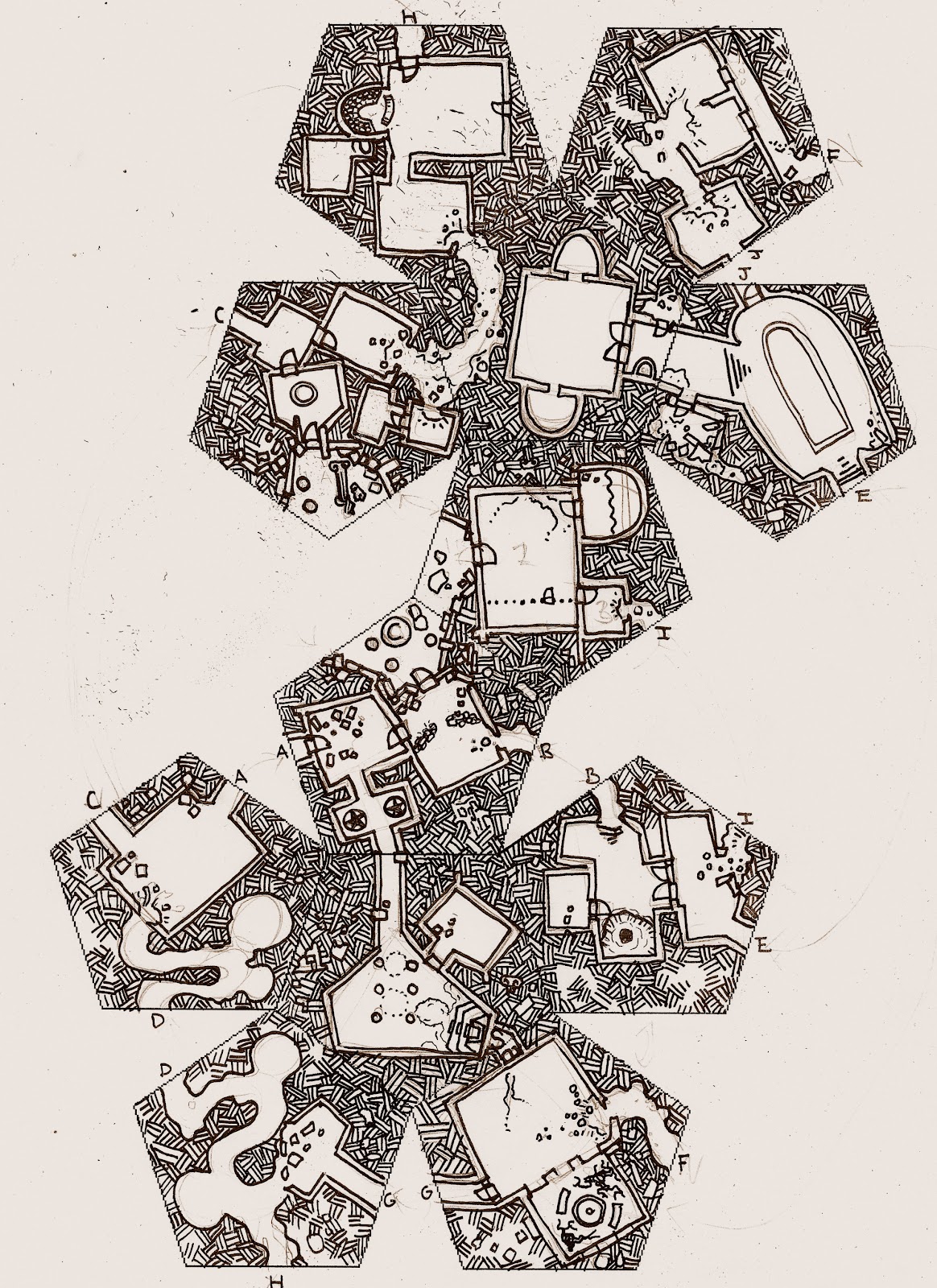
A Map - but not the one you want
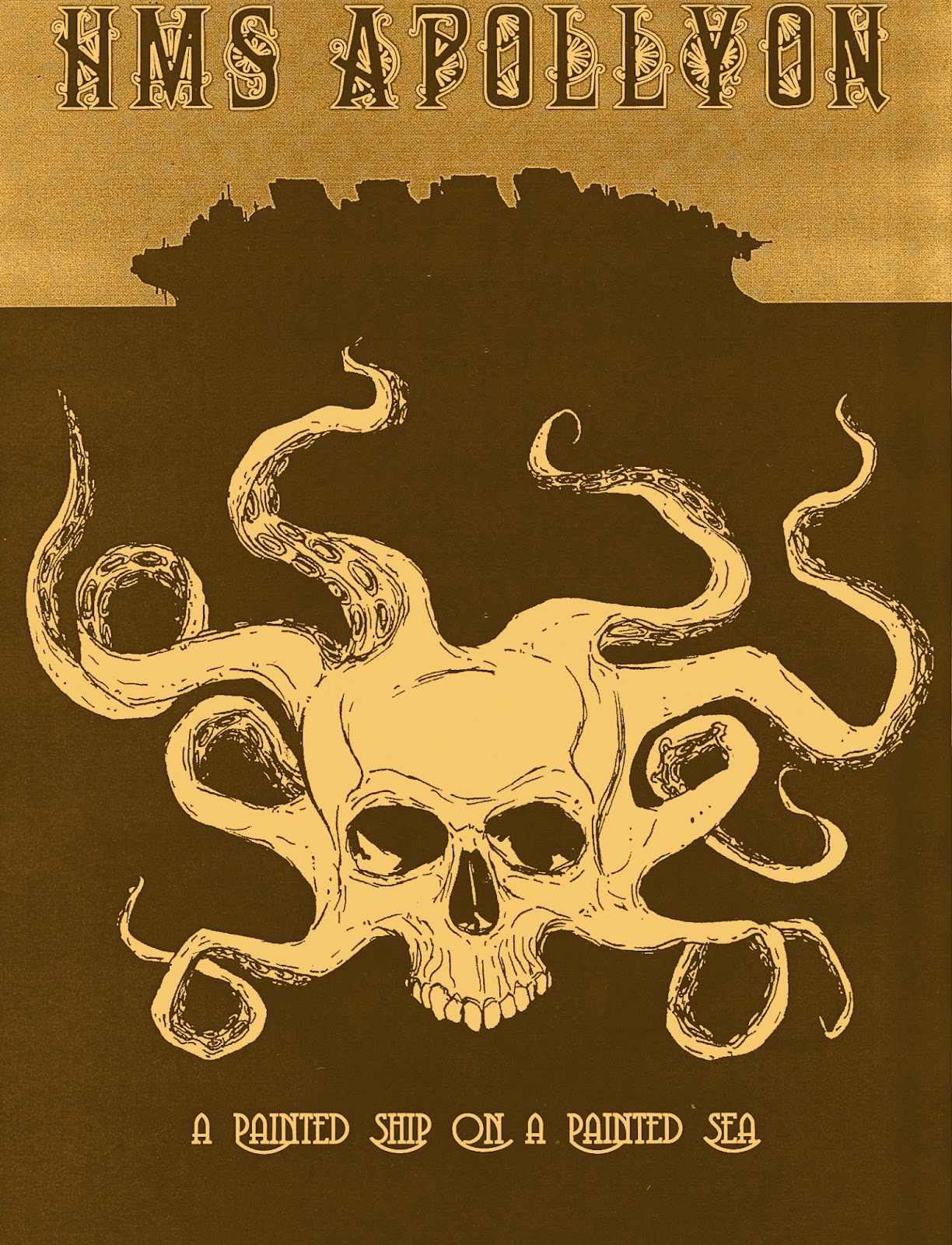
I jest, a reader asked for some maps related to my ongoing HMS APOLLYON
project - but I don't feel like publishing those, so here's a map of a twelve sided
folded unnatural space.
I am keying it up as a combination of the ruins of the folded city of an ancient
Carcosa imposed upon by the last bastion and hidden bunkers of the Iron King,
Hawberk I, who was deposed by its current Ragged King.
It's a bad place where refugees from Carcosa find themselves scavenging.
The project contains rooms like this:
Thursday, December 28, 2017
Gold for Experience in 5th Edition D&D
![]() |
| Classic David Trampier from the 1e |
This is perhaps the strongest aspect of the 5th edition brand - that makes motions in the direction of creativity and setting variation which some earlier editions refused to. Perhaps starting in the late 80's - early 90's as TSR released setting after setting, the idea embraced in the earliest editions of the game that each table of players and Dungeon Master should create their own world (I'd argue collaboratively), was abandoned and D&D products seemed to push an orthodoxy with settings defined and each setting deadened by reams of officious petty rules and mechanics. For example, the Spelljammer boxed set (a 1989 setting about fantasy space and space faring on magical sailing ships) spends little time offering up the sorts of strange and fantastical setting ideas it's core conceit promises, glossing over some great ideas in favor of complex rules about orbits and star types that seem more appropriate to a hard sci-fi game like Universe or Traveller. 5th Edition doesn't make this mistake, or at least it hasn't yet, and while I may critique its efforts at producing adventures for their devotion to the terminally bland Forgotten Realms setting and heroic fantasy, the Dungeon Masters Guide at least suggests Dungeon Masters design settings that vary greatly and offers some rules to aid in creating settings in 'mythic fantasy' (classical antiquity/mythology), 'epic fantasy' (even more high powered and magically focused), 'wuxia', 'dark fantasy' (Ravenloft effectively), 'mystery', 'intrigue' and 'swords and sorcery'. Sometimes rules are even offered up by the Dungeon Master's Guide to suggest how to better run these different sorts of campaigns.
The last category of 5e settings, "swords and sorcery", is largely a description of how earlier editions of D&D played (or perhaps were intended to play) - at least in my experience. Informed by the novels of Vance and other 30's - 60's pulp writers, this fantasy is a bit grim, and darkly humorous with heroes that are only slightly more impressive then normal men (or less in the case of Cudgel the Clever), who largely seek their own advancement and survive mostly by luck and their wits. The world is dangerous and uncaring, and if these sorts of wandering heroes become involved in an epic quest it is only by their own decision, a curse or accident.
The Little Brown Books or "White Box" are the first edition of Dungeons & Dragons - presenting a simple and somewhat muddled set of rules that almost compels a 'swords and sorcery' style setting and game (at least as the 5th edition Dungeon Master's Guide defines swords and sorcery) because the combat mechanics are high lethality, power levels flat and the exploration rules encourage caution and the accumulation of treasure rather then seeking combat.
Monday, December 4, 2017
SCENES FROM A SHIPWRECK - HMS Apollyon - Painted Ship on a Painted Sea - Adversary Design
One of the three main potential adversaries/NPCs within the Duke Brimstone Yacht Club area is Murial Coranado a 'Revenant of Debauchery' who is not especially hostile, but capable of life draining attacks and immune to non-magical weapons. If treated with respect and caution she is likely to be a curiosity and if plied with liquor may even become something of an ally and source of information about the ship, its history and the region.
I'm not a fan of 'Boss' monsters, and try to design my regions more so they present a puzzle, mystery and story rather then a series of challenges leading to a climactic fight. The other two potential adversaries (as opposed to simple monsters or random encounters like the Limpet Bears in the last post) are the angry spirit of a petty bureaucrat and a near unstoppable (but very stupid) giant sea slug. The Bureaucrat will grow increasingly angry if his domain is disturbed, while the slug will hunt the party pushing them deeper into the hull. All three are designed to present a variety of potential encounters and uses to the players, not only combat - though other then using the slug to dispose of other enemies, it's not really up for conversation.
- chairs and couches - Examination of the chairs will reveal that they appear to be made from a variety of shades of human skin, seemingly confirmed by the presence of a face here and there on the upholstery.
- Withered corpse - (Murial Coranado, Revenant of Debauchery) [See Sidebar] HD 4 (HP 16), AC 13*, ATK** +5x2 (Claw/Claw)***, INT 0, MV sluggish (3)
*Immune to normal weapons/explosions, damaged by fire, magic, silver, hexed and blessed weapons.
** Murial’s bony talons drain life from the victim on each strike, Save v. Paralysis or lose one level of experience/HD. Reduction to -1 LVL or 0HD causes instant death without Save.
*** As a Revenant of Debauchery Murial Coranado exudes reeking alcoholic fumes that will cause any creature in melee combat with her and capable of intoxication to become uselessly, reelingly drunk. Each round close to Murial combatants must Save vs. Paralysis to act at all.
Thursday, November 30, 2017
SCENES FROM A SHIPWRECK PART II - Grave of Giants Sample Rooms
GRAVE OF GIANTS
|
- From the confession of the Necromancer ‘Tenebrous’ on his treasonous dealings with the Ash Plague
Wednesday, November 29, 2017
SCENES FROM A SHIPWRECK - HMS Apollyon Painted Ship on A Painted Sea - Room Design
They also show my current approach to dungeon keying, which tries to both preserve the level of detail I find interesting and remain immediately useful to a Game Master during play.
DECADENCE AND DECAY
Duke Brimstone Yacht Club - Area A |
Tuesday, November 21, 2017
The Divine Wight - Part 7 Animals in the Jungle of Midnight
D12
|
Table 4 - Creatures of the Jungles of Midnight (*for stats listed below)
|
1
|
Giant Panthers* - A stalk of 1D6/2 Giant Panthers, 8’ - 12’ feet long and cruelly curious these creatures may stalk man-sized prey or lounge with yawning indifferent.
|
2
|
Dream Birds - Bursting with color and singing triumphant rilling songs in almost human voices, flocks of 3D6 of these birds are hunted for their plumage which is worth 100 GP a bird. Autochthons hunt them with wax stopped ears to avoid hearing their mournful death songs.
|
3
|
Slate Lizards* - Like dull blue river stones, up to 4d6 flat round lizards huddle on a bank or cling to the boles of trees - always basking in the sun. These creatures are no more aggressive or intelligent than any other 3’ long reptile, but being of the basilisk they are dangerous.
|
4
|
Prophetic Birds - Avian shapes made of pure inky night, these immaterial creatures exude the cold of the void and their movements are prophecy. A cleric may observe the birds to cast Augery without using a memorized spell on a successful 4D6 WIS check. On a failure the Cleric and companions are doomed with a -1 on all rolls (as a Curse)
|
5
|
Glass Deer* - Noble troops of deer, most are placid but the stags are territorial and can be aggressive. The glass deer of Jungles of MIdnight are transparent tending towards translucent with age and somewhat immaterial, but their flesh is still succulent, if light.
|
6
|
Blue Bees - The sweet drone of buzzing honey bees indicates the presence of a monumental hive of blue bees. Glassy and electric blue, the honey in their hives (unprotected raiders will be stung for 1D6 damage per round, for the 1D6 rounds it takes to recover each unit honey) is hallucinogenic, mildly poisonous and valuable - 250 GP per unit, with 1D6 units per hive.
|
7
|
Large Serpents* - 8’ to 18’ long these great constrictors are predatory and malicious,devoted to the Colossal Serpent they will be become placid if it is killed.
|
8
|
Glass Herons - Flying above in wedges that sparkle with sunlight or stalking fish in the river and pond shallows, these birds are like smoked blue glass with shearing beaks and brittle feathers that shatter with a tinkling snap.
|
9
|
Howling Monkeys* - Dirty slate, shambolic scavengers and thieves with 2-6 arms and wizened crafty faces. They make a near constant cacophony of hateful screams, seemingly from the sheer joy of disruption, and stink with their own foulness.
|
10
|
Butterfly Migration - Sapphire lords, a butterfly with a 2’ wingspan, rich vibrancy and long feathery antenna travel in locust like swarms. They are defenseless to the birds that trail after them nibbling at the edges of the swarm. THe birds dare not eat too many as the butterflys are deadly poisonous, even to a larger creature if eaten in bulk (a meal’s worth requires a Save v. Poison).
|
11
|
Crocodiles* - Mottled purple, blue or grey the crocodiles of the Midnight Jungle are oppressed and disdained by their divinely inspired brethren, but they can be as mean and dangerous as any hungry 6’ - 10’ reptile - hunting in the river’s shallows.
|
12
|
Swarm Fish - A colony of thousands of fish, moving with singular intent and mind, flashing blue and silver glass in the water the fish swarm is curious, but largely harmless. An excellent food source it can easily be tricked into sacrificing some of its members - going so far as to risk 1D6 rations worth of fish leaping into a net or boat to investigate any sparkling objects displayed within.
|
Sunday, November 5, 2017
The Divine Wight Part 6 - Jungle Tables 2 and 3: Landmarks and Hints
Landmarks and areas of interest are often found in the Jungle of Midnight, and are useful as they provide points that a lost party can often find their way back to.
D10
|
Table 2 - Landmarks in the Jungle of Midnight
|
1
|
Abandoned Village - The sense tragedy fills this clearing, and above hangs the unraveled crumbled ruins of an Autochthon village. A search will reveal a dread emblem of corrupt magics and/or a midden of cracked fire roasted human bones.
|
2
|
Marble Ruins - Graceful arches, fluted columns and decoratively carved blocks crumbled and scattered by time. Often these ruins are blanketed with flowers.
|
3
|
Waterfall - From a high plummeting cataract to a series of small drops and turbulent rapids, waterfalls in either jungle streams or the great river make a cacophony of falling water can be heard for miles, making them excellent spots for an ambush.
|
4
|
Legion Post/Grave - Ancient forts and cenotaphs of sorcerously sculpted stone mark the Jungles of Midnight as a former march of the Imperial Legions. These near imperishable vestiges slowly sink beneath the riotous life of the jungle.
|
5
|
Improbable Growth - Groves of tall bare trees with roots that erupt in lavender foliage, meadows of tree sized orchids and twisted paths wending through man-high succulents.
|
6
|
War Machine - Trapped in vines and entangled by jungle trees, the twisted remnants of an ancient Imperial Colossus towering above the canopy, the crushed crumbled stones of a floating Vheissuian fire temple blanketed in pink coral like growth or the moss colored stone bones of a dire wyrm are a monument to ancient wars.
|
7
|
Autochthon Village - Like mussels clinging to a rock, the people of the Jungle build their homes from wicker and black clay, stuck fast in the branches of the greatest of forest giants. Among the foliage and fruits the Autochthons can go about their domestic tasks protected from many of the Jungle’s predators.
|
8
|
Stone Face - Colossal and timeless, carved boulders or entire sheer cliffs marked by vanished carvers with a variety of faces: human, beasts or god.
|
9
|
Monolith - A marker of forgotten deeds, antediluvian or simply ancient. The history of the great stele and rain channeled statues is lost, but they still stand in the jungle.
|
10
|
Bone Yard - A stinking hole in the jungle, like a cancerous growth, where the bones of unlikely beasts and slaughtered sentients rot in great, piles of spongy yellow on brittle bleached white.
|
11
|
Dead Water - Glassy clear to the depths of the river, where the pristine wreck of an ancient war machine rests, tangles of wire and struts of bonewhite gleaming among polished river stones this area of river is devoid of life. The water here is a polluted sink of deadly magics. Drinking it or swimming here requires a save vs. poison (every round for a swimmer) or it results in a convulsive, corrosive death.
|
12
|
Bridge - A thin span of near translucent marble, ancient beyond reckoning, a tumble of fallen logs, tangled artfully with vines, or a brutal manipulation of bedrock into a low arch that marks the Successor Empire’s poor grasp of military geomancy.
|
Wednesday, November 1, 2017
The Divine Wight Part 5 - Jungle Encounter Table 1: Monsters.
BEAST OF THE JUNGLE
|
D10
|
Dangers of the Jungle of Midnight
|
1
|
Autochthons (3D6) - A band of Autochthon hunters or gatherers, peaceably finding their sustenance. They may be fishing for glassy eels from a bark canoe on the river, checking fish traps in a jungle rill, digging purple bulbs from the undergrowth or stalking birds, many armed monkeys and fat slate lizards. They are usually suspicious, unfriendly and ready to flee.
|
2
|
Brutes (2D6) - From deep in the jungle, hulking, slope skulled, dulled eyed and decked in bones, these massive warped humans hunt and kill, and their favorite prey is their fellow man. Brutes travel in bands and are usually hostile unless they have recently eaten.
|
3
|
Owlbears (2D6) - Usually arcanovore scavengers, the jay feathered ‘growlyhoots’ of the Midnight jungle have grown more predatory in an environment where all life is infused with magic. They are lean pack hunters, tracking, circling, and distracting their prey with quizzical hooting and then rushing in from the rear to drag it down beaks snapping.
|
4
|
Hunting Glass (1) - Filaments of spun blue glass drape the trees and form mystical sigils that can stun a warp the mind. Above its trap of symbols, hangs a colony of hunting glass, it will subsume and devour prey that becomes hopeless under the effect of its symbols.
|
5
|
Blue Monks (2D6) - blue monks roam from the city on a mission from their “god”, they are unlikely to talk but also unlikely to attack, preferring to return immediately to the city a inform their fellows before organizing a hunt for trespassers to sacrifice.
|
6
|
Azure Apes (1D6) - Monstrous, four armed horrors are cavorting in a clearing, gorging on fruit, hooting at each other, smashing termite mounds or travelling in a line. They can rarely resist the distraction of crushing smaller ape-like creatures.
|
7
|
Revenant Legion (4D20) - Only the geases of the ancient empire and perverse professionalism keep this company of ghoulish soldiers endlessly marching. They plod slowly, noisily through the forest in rusted armor, with broken weapons in warped, lichen splotched hands. The legion has no mission beyond the ceaseless march and sating their undead cannibal hunger.
|
8
|
Cockatrice (1) - small and solitary, the blue cockatrice is one of the jungle’s greatest predators. It will hunch silently (often in a stolen nest over crystallized eggs) and then burst into its beautiful and and deadly song, leaving prey a fragile petrified statue of blue crystal.
|
9
|
Razor Birds (1D6/2) - A quarrelsome and deadly flock of tall birds, somewhat akin to giant cassowary’s except with long wispy feathers of gentle purples and black over scaled skin that gleams like quicksilver. They are territorial, sadistic and fond of trapping prey in covered pits.
|
10
|
Colossal Serpent (1) - over 60’ long this leviathan of the forest has grown almost immortal from devouring godflesh, and is far more intelligent and malicious than any mere animal. It coils in a great pool below a waterfall, whose bottom is blanketed with bones. The snake considers anything the enters the pool a sacrifice to its divinity but will not attack those who offer proper sacrifice.
|
11
|
Divine Crocodiles (1d6+1) - A pack of crocodiles polluted by the Beaked God’s presence, they are blue and each has a huge third eye, capable of emitting a beam (BV 3 at range, single melee target) that turns all who fail a save vs. paralyzation into glass. The strange creatures guard sunken ruins and are never far from some piece of ancient carved marble.
|
12
|
River Draugr (1D6/2 ) - The bodies of drowned explorers, slither from their river den and float to the surface, waiting for ‘rescue’. The Dragur will demand help in blubbering watery voices, with bloated faces weeping bloody tears. If offered a line they either try drag rescuers to the river bottom or sit sullen faced in the rescuers’ boat, obviously dead, and waiting for a chance to stave in the boat’s bottom or seize the helm and dash it against rock.
|